Reading the Ride: Digital Tools That Check Your Motor Oil Quality
Originally published September 25, 2012. Updated May 25, 2026.

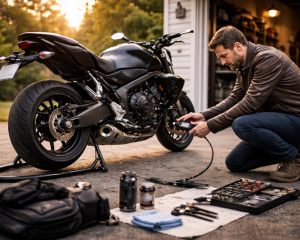
Most riders still judge engine oil the old way: the colour on the dipstick, the smell, the feel between finger and thumb.
There is nothing wrong with that ritual. It belongs to the garage as much as tyre pressure, chain slack, and the quiet pause before a long ride. But oil can tell a more complicated story than colour alone reveals.
That is where digital oil-condition testers come in.
These small garage tools are designed to give riders a quick indication of oil health before the next service interval arrives. They do not replace a service manual, and they certainly do not replace a proper laboratory oil analysis. But used carefully, they can add another layer of information to a rider’s maintenance routine.
What These Tools Actually Measure
Most consumer oil-condition testers work by reading changes in the electrical properties of the oil. As engine oil ages, oxidises, collects contaminants, or becomes diluted, its behaviour can change.
Some devices give a simple good/borderline/change reading. Others provide a numerical score that can be tracked over time.
More advanced testing — including wear metals, coolant intrusion, fuel dilution, viscosity, and insolubles — is still the domain of laboratory oil analysis.
That distinction matters.
A handheld tester can be useful. A lab test can be diagnostic.
Why Riders Use Them
Oil does not always look bad when it is beginning to lose its protective qualities.
A bike used for short trips, hot traffic, hard riding, wet weather, or long storage may stress its oil differently from a bike that spends its life on steady open roads. Mileage alone does not tell the whole story.
That is the appeal of a digital oil reader. It gives the owner a quick check between scheduled changes, especially on older motorcycles, high-mileage engines, or bikes running premium synthetic oil where the rider wants more confidence before draining it early.
Are They Worth It?
For casual riders who change oil on schedule, probably not essential.
For riders who stretch intervals, own several motorcycles, use expensive synthetic oil, ride in heat, or maintain older machines, they can make sense. They are especially useful when readings are recorded over time, because the trend may tell you more than a single test.
If a reading suddenly changes, that does not automatically mean the engine is in trouble. It means the oil deserves attention — and possibly a proper lab analysis.
Digital Oil Testers Worth Knowing
Handheld optical oil testers
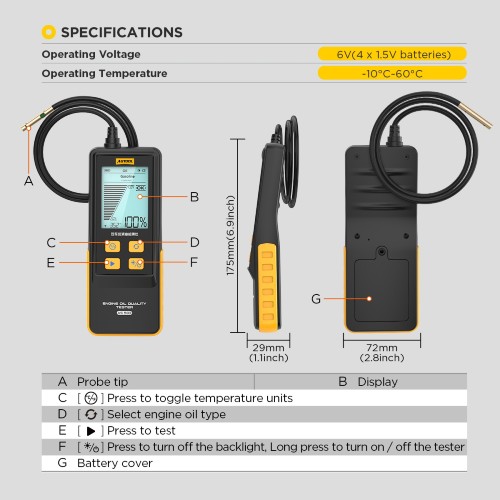
Several budget-friendly oil testers — including models sold under names such as AUTOOL AS503 and CMTOOL — use optical sensing to measure how much light passes through the oil. In simple terms, they are looking at oil transmittance: cleaner oil lets more light through, while darker or more contaminated oil lets less through.
These tools can be useful for a quick garage check, especially when comparing readings over time. But they should be understood as screening tools, not diagnostic instruments. They can suggest that oil has aged, darkened, or collected contaminants; they cannot tell you exactly what is inside the oil the way a laboratory analysis can.
Best for: riders who want a quick check between oil changes, or anyone inspecting a used motorcycle where the oil story does not quite match the seller’s words.
Spectro Scientific FluidScan® 1000 Series
The FluidScan 1000 belongs in a different class. It is a professional handheld infrared oil analyzer designed for field use, not a casual garage gadget. Spectro describes it as measuring lubricant condition markers such as oxidation, water, glycol, soot, TAN/TBN, and additive depletion, using infrared spectroscopy. It is also associated with ASTM D7889 field-analysis methodology.
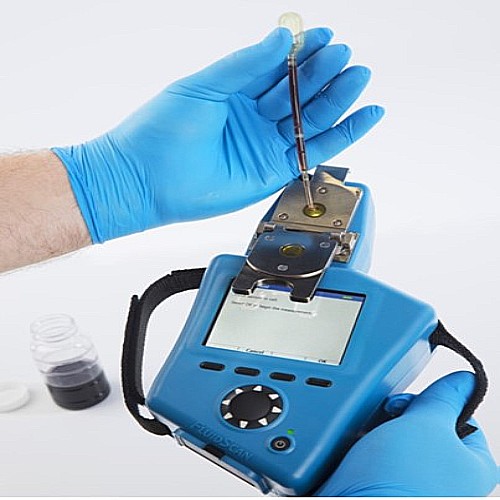
For most riders, it is far beyond what is needed. But it shows where portable oil analysis becomes serious diagnostic work.
Best for: workshops, fleets, race teams, and riders with a very serious maintenance programme.
Then your comparison table becomes simpler and more credible:
At a Glance
| Tester type | Examples | What it can indicate | Best for | Limits |
|---|---|---|---|---|
| Handheld optical/transmittance tester | AUTOOL AS503, CMTOOL-style units | Oil darkening, contamination signs, temperature, general condition reading | Everyday riders, used-bike checks, basic garage monitoring | Not a lab test; cannot identify wear metals, coolant traces, or exact chemical breakdown |
| Professional infrared analyzer | Spectro Scientific FluidScan® 1000 | Oxidation, water, glycol, soot, TAN/TBN, additive depletion, lubricant condition | Workshops, fleets, race teams, reliability professionals | Expensive, technical, and excessive for most casual riders |
| Laboratory oil analysis | Blackstone-style mail-in analysis | Wear metals, viscosity, fuel dilution, coolant indicators, water, insolubles, additive package | Diagnosing engine health or tracking long-term wear | Slower, requires mailing a sample, not instant garage feedback |
The Garage Read
Handheld optical testers are the practical garage choice: quick, affordable, and useful for spotting changes in oil condition between scheduled services.
Professional infrared analyzers are the serious workshop route, offering deeper lubricant-condition data but at a price and complexity most riders will not need.
Laboratory oil analysis remains the most complete answer when you want to understand engine wear, contamination, viscosity, and the longer mechanical story behind the oil.
Before the Next Ride
A digital oil tester will not replace your senses. It will not replace fresh oil, a clean filter, or the service schedule in the manual.
But it can sharpen the old garage ritual.
A few drops of oil, a quick reading, and one more piece of information before the next ride. Not certainty, exactly — motorcycles rarely give us that — but a little more confidence that the engine beneath you is still being protected.