Bringing a Motorcycle Back from Winter — A Return to the Road
After months of stillness, the first ride begins long before the engine turns — in the small checks, quiet adjustments, and the gradual return of rhythm between rider and machine.

The beginning of a riding season rarely announces itself. It arrives gradually — a change in the air, longer light in the evening, the sense that movement is possible again.
For months, the motorcycle has been still. Not neglected, but suspended. Waiting without urgency, carrying the memory of motion in components designed for it.
The return is not immediate. It should not be.
Bringing a machine out of stillness is less about preparation in the conventional sense, and more about re-establishing balance — between systems, between surfaces, between expectation and response.
The First Look
The process begins without tools.
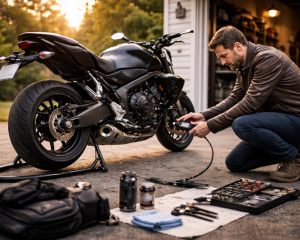
A visual inspection, taken slowly, often reveals more than any measurement. Tyres come first — not simply pressure, but condition. The faint flattening that comes from bearing weight without movement. The subtle cracking that appears with time rather than mileage. Tread depth matters, but so does age, and the quiet way rubber changes when left still.
Brakes follow. Pads, rotors, and lines rarely fail without warning, but they do communicate neglect in small ways — uneven wear, slight discolouration, fluid levels that have shifted just enough to notice.
Lights return to importance in the early season. A functioning headlight or indicator is less about compliance than about presence, particularly in conditions that are still shifting between winter and spring.
Fluids sit at the centre of everything. Oil, coolant, brake fluid — each carrying a function that is only noticed when compromised. Levels matter, but so does clarity. Colour, consistency, and the absence of contamination all indicate how well the machine has endured its time at rest.
The chain or belt, the battery, the cables — quieter systems, often overlooked. A chain dries slightly over time. A battery loses charge gradually, without drama. A throttle cable may feel almost the same, but not quite.
Nothing here is dramatic.
That is the point.
Before any of that, though, there’s the quieter work — a few early-season checks, the small things that make the first miles feel right again.
Fluids
Machines are designed for circulation.
Engine oil does more than lubricate — it carries heat, residue, and time. Even without use, it degrades. Coolant stabilises temperature, maintaining a range the engine depends on. Brake fluid translates pressure into stopping force, its reliability shaped by its condition.
Moisture, introduced gradually, alters that condition. Discolouration is not aesthetic — it is information.
Some motorcycles require separate transmission oil. Others share systems. In either case, the principle remains the same: fluid condition defines mechanical behaviour long before failure appears.
Fork oil, often overlooked, determines how the front of the motorcycle responds — not in extremes, but in small moments that shape confidence.
These systems rarely demand attention loudly.
They ask for it quietly, and consistently.
Lubrication
Friction is inevitable. Wear is not.
The chain or belt transfers power continuously, exposed to the environment, subject to tension and contamination. Lubrication maintains function, but excess invites debris — the balance is precise.
Cables — throttle, clutch, brake — depend on smooth movement. Modern systems may reduce the need for intervention, but not entirely remove it. Bearings, whether in wheels, steering head, or swingarm, rely on lubrication that is rarely seen but always felt.
Application matters. Even coverage, without excess. Enough to protect, not enough to attract.
Lubrication is less about adding, more about maintaining.
Air and Flow
An engine breathes before it performs.
The air filter defines the quality of that breath, preventing debris from entering while allowing sufficient flow for combustion. Over time, restriction builds — sometimes gradually, sometimes without being noticed.
The exhaust completes the exchange. Damage or obstruction alters not only sound, but behaviour.
Between intake and exhaust, the fuel system maintains proportion. Carburetor or injection — both depend on clean pathways and balance. A system that has sat unused may run slightly rich or lean, not enough to fail, but enough to change how the engine responds.
The cooling system operates quietly in the background, maintaining temperature within a narrow range. When compromised, it reveals itself slowly, then all at once.
Each of these systems depends on movement.
Stillness interrupts that movement.

The First Movement
Eventually, inspection gives way to action.
The engine starts, sometimes immediately, sometimes with hesitation. It settles into idle, then steadies. Heat begins to move again through components that have not carried it in months.
There is a rhythm to this — not yet riding, but no longer still.
It isn’t just the machine that needs attention — the rider does too, especially after time away from the road.
Muscle memory returns, but not immediately. Inputs are more deliberate, reactions slightly delayed, awareness narrower than it will be later in the season.
The First Ride
The first kilometres are not about distance.
They are about confirmation.
Brakes are tested progressively, throttle applied with restraint, the feel of the machine returning in increments rather than all at once. Suspension reveals itself over uneven surfaces. The engine settles into familiar ranges.
If anything feels uncertain, it usually is.
There is no advantage in ignoring it.
And once everything is in place, the first ride has a way of confirming what inspection alone cannot — a return not just to motion, but to familiarity.
Returning to Motion
When the ride ends, it does not end abruptly.
The engine is allowed to idle. Heat dissipates through metal that has remembered movement. The small sounds of cooling — ticking, settling — return with a familiarity that was absent before.
The machine returns to stillness in a different state than it left it.
Not dormant.
Not waiting.
Ready.
A new riding season does not begin with speed or distance. It begins with attention — to the machine, to the rider, and to the quiet details that shape everything that follows.
A return, reduced
What follows is the same process, reduced — not to simplify it, but to make it easier to return to.
- Tyres — pressure, condition, age
- Brakes — pads, rotors, fluid, lines
- Fluids — oil, coolant, brake
- Drive — chain or belt, tension, lubrication
- Battery — charge, terminals
- Controls — throttle, clutch, brake feel
- Air & fuel — filter, intake, system condition
- Suspension — leaks, balance
- Start — idle, sound, vibration
- Ride — short, deliberate, attentive
Part of our early-season riding series.