Belstaff Trialmaster — A Motorcycle Jacket Worth Growing Old With
The Short Line
- Buy the motorcycle version: if you intend to ride, the Trialmaster Motorcycle Icon offers substantially more protection than the similarly styled lifestyle jacket.
- More than nostalgia: waterproofing, D3O armour, reinforced impact areas and AA certification make the current Trialmaster a legitimate motorcycle jacket.
- The real advantage: few riding jackets work as naturally once you park the motorcycle — and even fewer look better as they grow older.
There is something slightly irrational about wanting a Belstaff Trialmaster.
Walk into a motorcycle shop today and there is no shortage of impressive alternatives. Laminated fabrics, sophisticated ventilation systems, removable thermal layers, advanced armour and jackets designed to perform in almost every imaginable condition.
Then there is the Trialmaster.
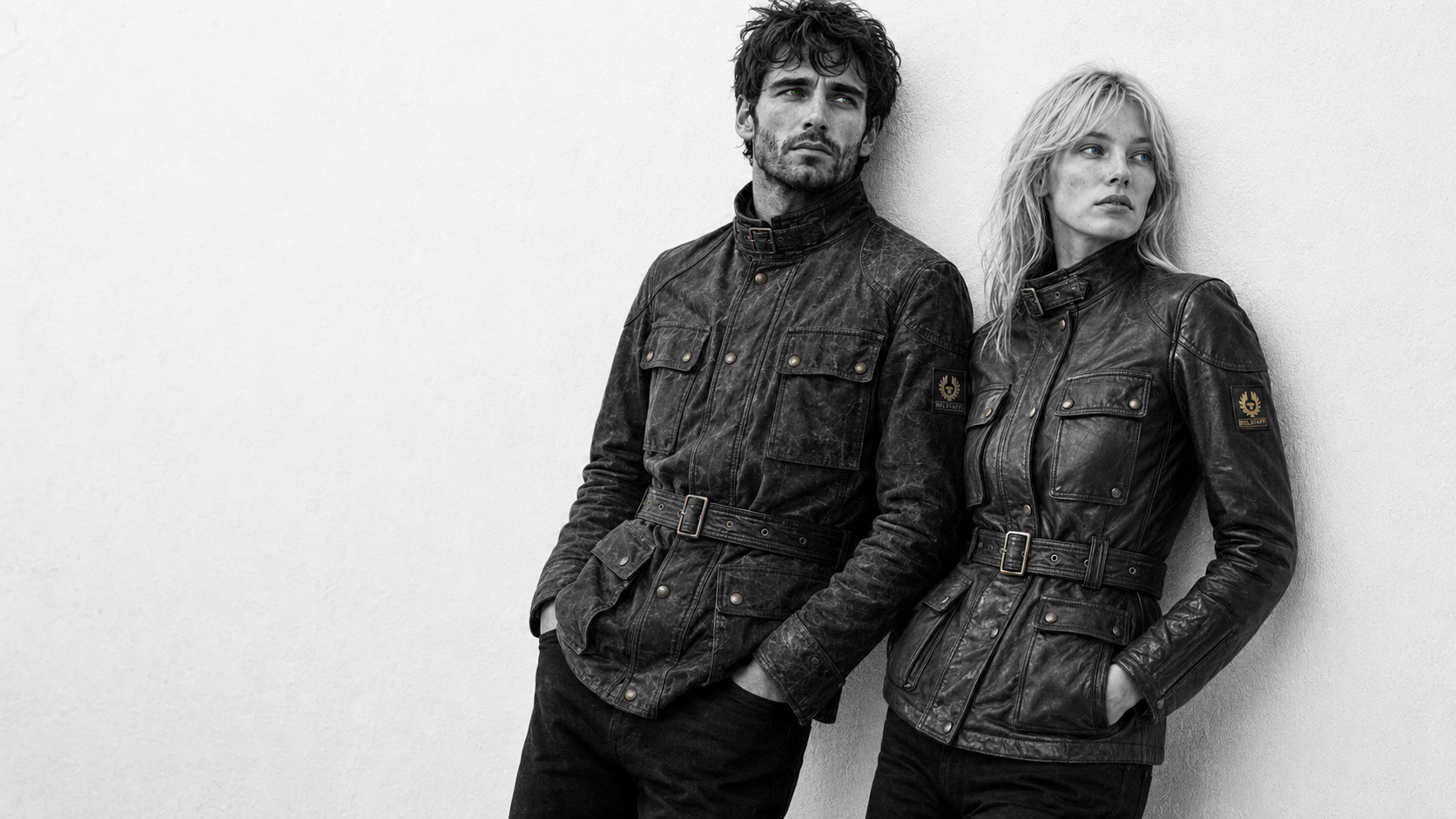
Four pockets. A belt. Waxed cotton. A collar that looks as though it belongs in an old photograph.
And somehow, more than seventy-five years after it appeared, you still want one.
It began before the Trialmaster
Belstaff’s story starts before the jacket that made its name.
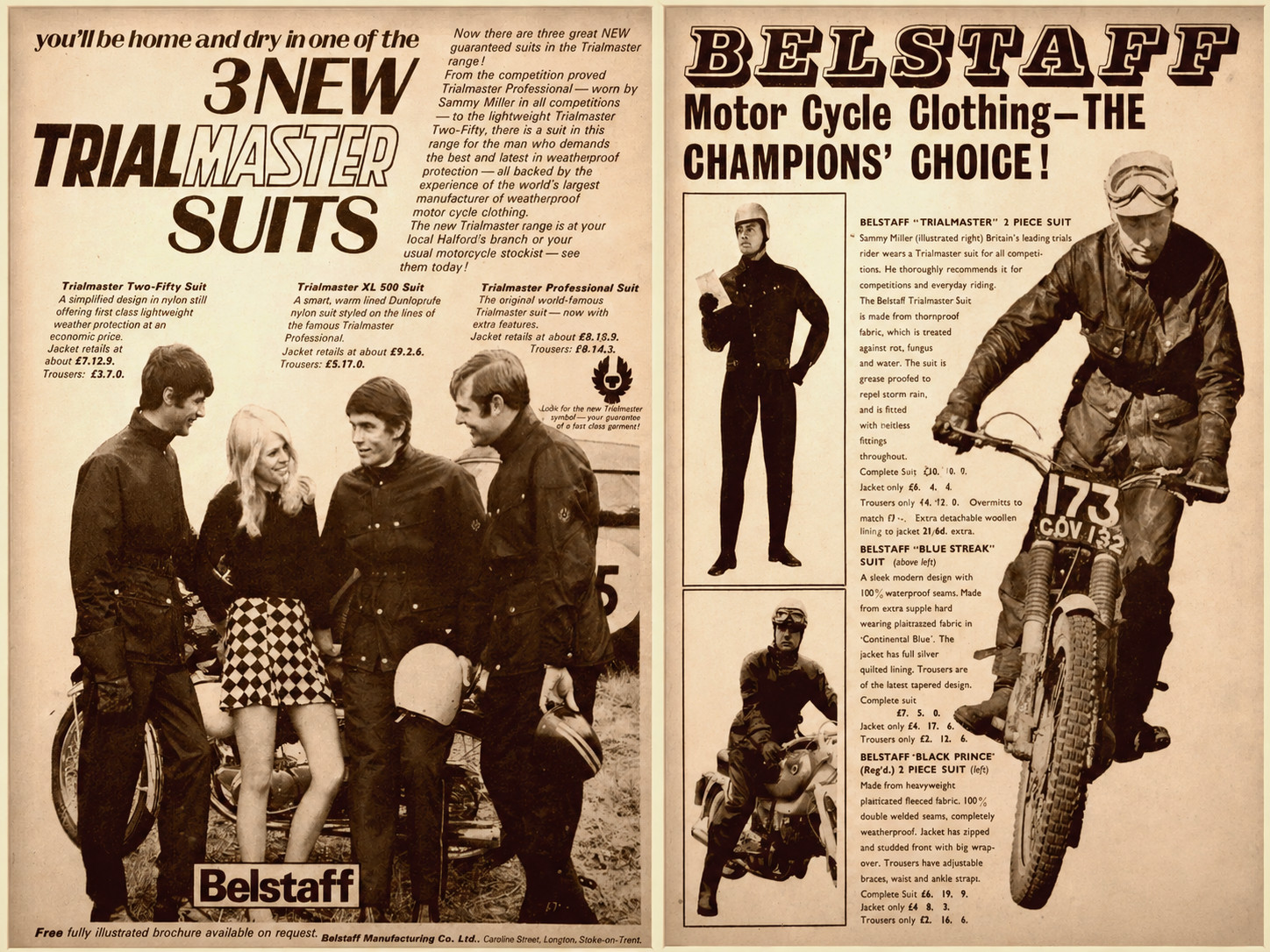
The company was formally established in Stoke-on-Trent in 1924 by Eli Belovitch and his son-in-law Harry Grosberg, but the family was already working with waterproof fabrics before then. Their interest was practical rather than fashionable: making clothing capable of keeping people moving when the weather turned against them.
Motorcyclists were an obvious audience. So were racing drivers, aviators, soldiers, mountaineers and explorers. Over the decades Belstaff produced protective clothing for all of them, gradually building its reputation around one simple idea — outerwear should allow you to go farther rather than give you another reason to turn around.
Waxed cotton became central to that philosophy. Tough, breathable and capable of being reproofed rather than discarded, it offered an unusually effective solution before synthetic waterproof membranes existed.
Then, in 1948, came the jacket that distilled those ideas into one design.
The Trialmaster was developed for the brutal conditions of the Scottish Six Days Trial. Pre-curved sleeves allowed a more natural riding position. The high collar kept weather away from the neck. A belt controlled the jacket at speed. Four large pockets carried the essentials, while the distinctive slanted chest pocket put a map within easier reach. Belstaff still uses those details today.
What began as competition equipment became something far larger.
Trial riders wore it because it worked. Adventurers adopted it for much the same reason. Eventually actors, travellers and people who had never ridden a motorcycle wanted one too.
Fashion discovered the Trialmaster only after the road had already proved it.It survived Belstaff itself
The Trialmaster’s longevity becomes more remarkable when you look at the company behind it.
Belstaff did not glide effortlessly from British motorcycle manufacturer to modern fashion house. Like much of Britain’s traditional clothing industry, it went through difficult years, factory closures and financial trouble.
The Malenotti family acquired the business in 2004 and pushed Belstaff more decisively into international fashion while retaining the motorcycle history and archive that made the name valuable in the first place.
Ownership changed again in 2011, passed to INEOS in 2017 and then to British sportswear company Castore in 2025.
Companies change. Owners change. Factories disappear.
The Trialmaster remained recognisable through all of it.
That says something about the design.
Is it really worth the money?
This is where heritage has to stop doing the work.
A motorcycle jacket still has to function as a motorcycle jacket.
Belstaff currently offers both a lifestyle Trialmaster and a dedicated motorcycle version that look deceptively similar at first glance. The difference matters.
The standard Trialmaster Icon Jacket uses lighter British Millerain waxed cotton and carries the classic shape beautifully. It is premium heritage outerwear, but it is not the version I would choose primarily for riding.
The Trialmaster Motorcycle Icon Jacket is a different proposition.
It uses heavier 8 oz British Millerain Ultracore waxed cotton, a breathable waterproof membrane and high-tenacity nylon reinforcement at the shoulders and elbows. D3O armour protects those areas, there is underarm ventilation, and the complete garment carries a CE AA motorcycle rating.
If you want the look, the standard Trialmaster makes sense.
If the motorcycle is the reason you are buying one, choose the Motorcycle Icon.
What the specifications don’t explain
Even that does not entirely answer why someone would spend premium money on a waxed-cotton jacket when more technologically advanced alternatives exist.
The real appeal of the Trialmaster appears when the motorcycle stops.
A modern touring jacket can be extraordinarily capable at motorway speeds in pouring rain and still make you look as though you are waiting for the Dakar support truck when you walk into a small restaurant.
The Trialmaster makes that transition unusually well.
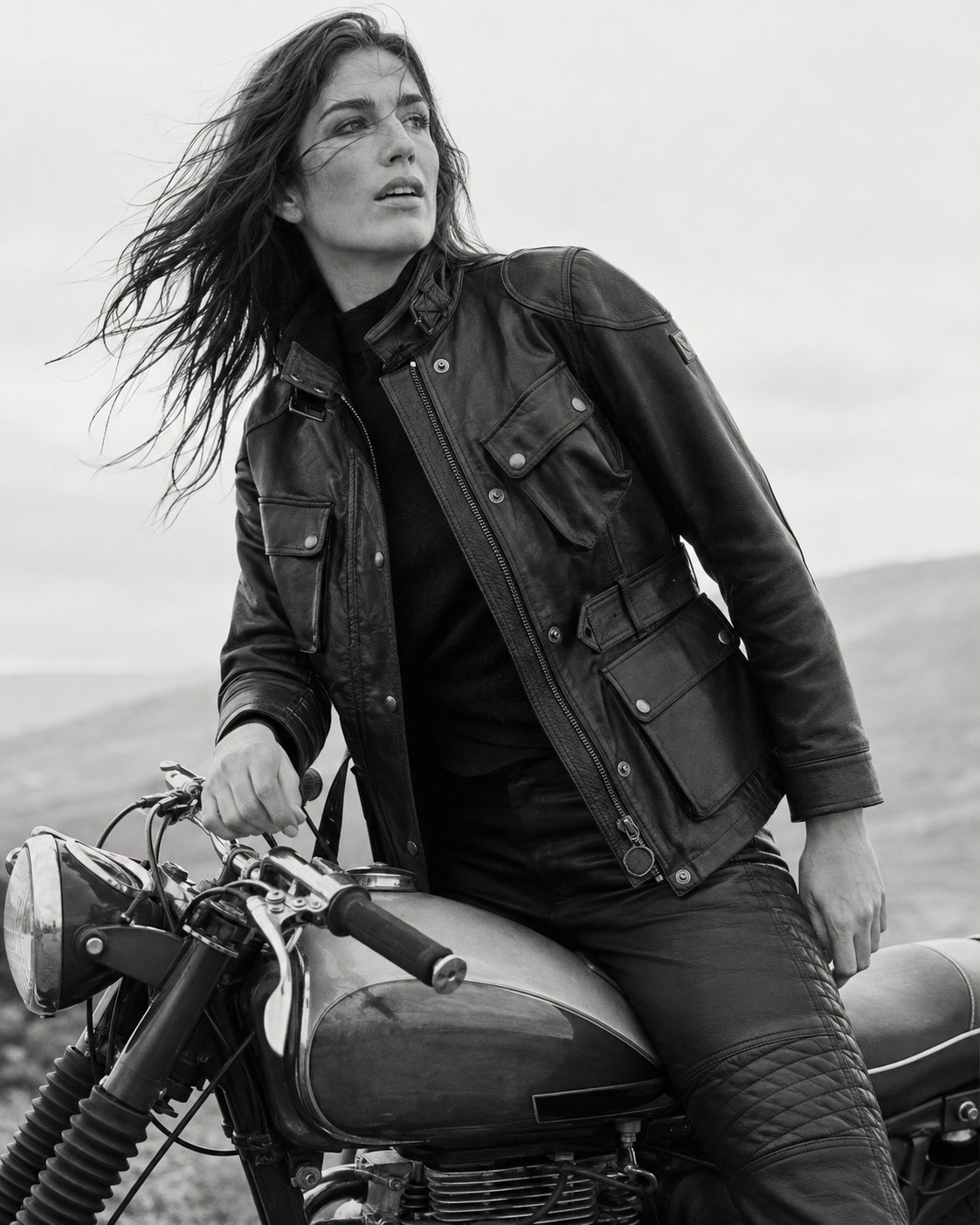
Ride into a town, leave the helmet with the bike and the same jacket becomes an ordinary piece of clothing. Not motorcycle clothing pretending to be casual clothing. A genuinely handsome jacket.
For touring riders, that has practical value.
One jacket can take you through a morning on the motorcycle, an afternoon walking through a city and dinner that evening without requiring another coat in the luggage.
Suddenly the old-fashioned design seems rather modern.
Waxed cotton gets old differently
There is another reason people become attached to these jackets.
Most technical clothing looks best on the day you buy it.
Waxed cotton often does not.
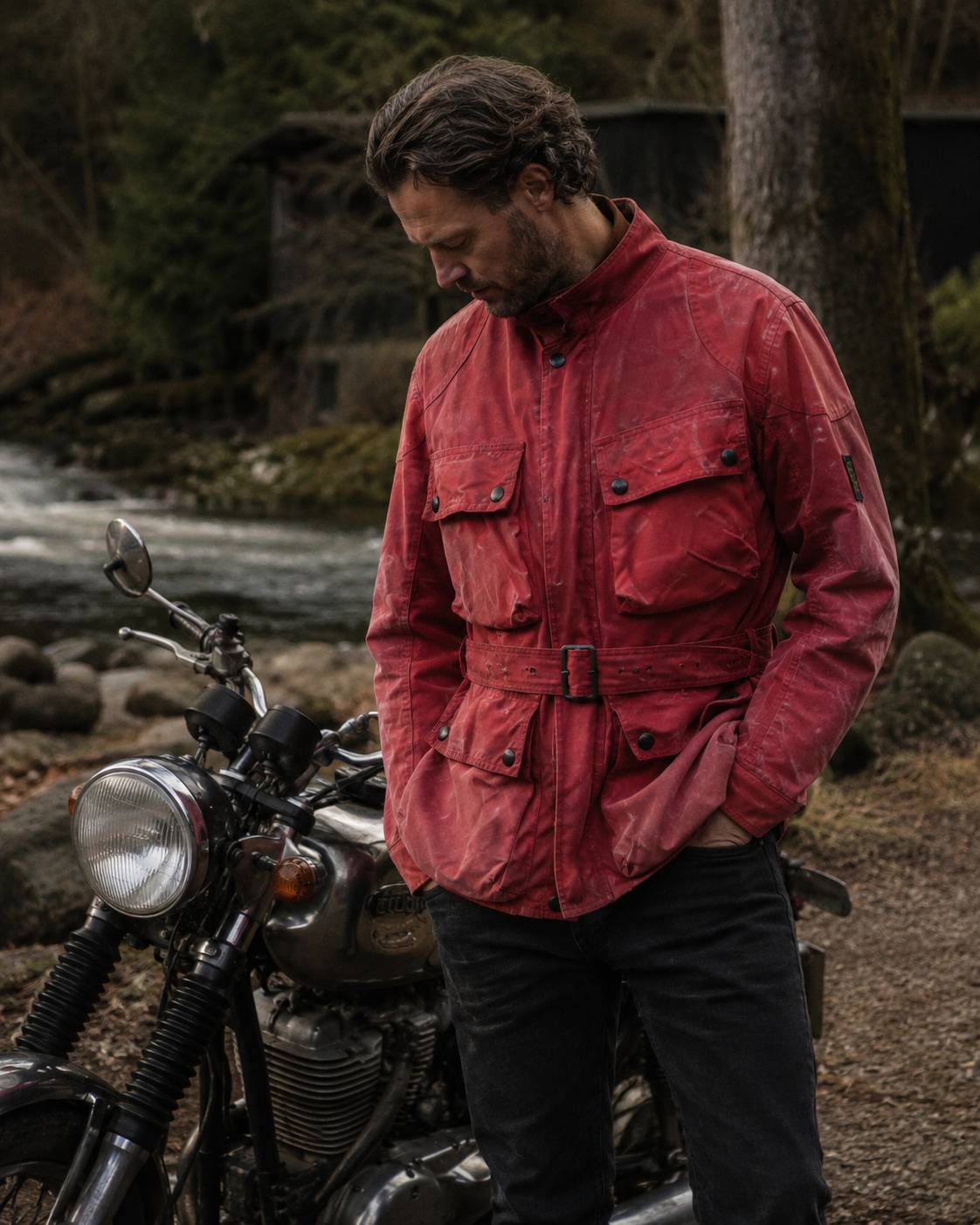
It creases at the elbows. The surface changes where your arms bend. Edges lighten. Rain, movement and use slowly alter the finish.
Then you rewax it.
The process restores weather resistance but does not completely erase what came before. Over time, the jacket begins to carry a record of how it has been used.
That is difficult to put on a specification sheet.
It also changes how you think about the cost. A premium jacket bought for a few seasons is expensive. A jacket worn, maintained, rewaxed and repaired for ten or fifteen years becomes a different proposition.
The Trialmaster encourages that kind of ownership.
There are compromises
Romance should not get in the way of reality.
The Trialmaster Motorcycle Icon is not necessarily the best jacket for every rider.
If I were crossing Europe through relentless winter rain, I might prefer a modern laminated touring suit. In extreme summer heat, there are far better ventilated options. Riders prioritising maximum protection can also find garments with higher specifications and more comprehensive armour systems.
Waxed cotton requires maintenance. That is part of the relationship. Occasionally it needs cleaning and rewaxing rather than simply being thrown into a washing machine.
So buying a Trialmaster does not buy you the objectively greatest motorcycle jacket.
It buys a particularly good solution to a different problem:
How do you make one jacket belong equally to the motorcycle and to the life happening around it?
That is where the Trialmaster becomes difficult to replace.
Or buy somebody else’s history
There is another route.
When we first wrote about the Trialmaster back in 2013, Belstaff also offered the Tourist Trophy, often referred to simply as the TT.
It belonged to an earlier generation of serious Belstaff motorcycle jackets and could be considerably heavier than today’s model, with versions made from substantial waxed cotton and equipped with armour, waterproofing and removable insulation.
Later protective jackets also appeared under the Trialmaster Pro name.
Neither is part of Belstaff’s present range, but examples still circulate second-hand — and good ones remain desirable among riders who appreciate the heavier construction and older character.
That can make the used market particularly interesting.
A well-kept TT or Trialmaster Pro can offer a less expensive way into a genuine Belstaff motorcycle jacket while giving you something no new jacket can provide: a little history before you have even started making your own.
Condition matters more than age.
Check that the armour is present and still suitable for use. Inspect the seams, lining and membrane. Make sure the zips and press studs work properly and pay particular attention to the shoulders, elbows, cuffs and waist.
Dry wax can be dealt with.
Damaged fabric is another matter.
And do not be frightened by a few creases.
On a jacket like this, they may be the best part.
A word about protection
The Trialmaster Motorcycle Icon is genuine protective motorcycle clothing, but that should not be confused with saying waxed cotton is the most protective material available.
The current jacket carries an AA rating under EN 17092, which means the complete garment has been tested for abrasion resistance, tearing and seam strength as well as impact protection. AA represents a substantial level of road and touring protection, but AAA is the highest classification under the standard.
Leather and modern technical textiles can be built to considerably higher levels of abrasion protection, although material alone never tells the whole story. Construction, seams, reinforcement, armour, fit and the certification of the complete garment all matter.
So the Trialmaster should be understood for what it is: a protective, AA-rated motorcycle jacket that places unusual emphasis on versatility, weather protection and timeless design. Riders looking for maximum abrasion or track-level protection should consider higher-rated technical textiles or purpose-built leather equipment instead.
The long way around
From aviators such as Amelia Earhart to riders and travellers generations later, Belstaff became associated with people who went somewhere rather than simply dressed as though they might.
Ewan McGregor’s eventual collaboration on the McGregor Pro was therefore less a reinvention of the brand than a continuation of something Belstaff had been doing for decades.
For Long Way Up, McGregor did more than simply wear a Belstaff. He worked with the company to co-design the McGregor Pro, a heavily modified interpretation of its classic four-pocket motorcycle jacket.
McGregor went through the Belstaff archive for inspiration and based much of the design around a vintage Trialmaster made for an American motorcycle team. The finished jacket used heavy 12 oz waxed cotton from Scottish mill Halley Stevensons, a waterproof breathable membrane, leather reinforcement at the shoulders and elbows, D3O armour and — at McGregor’s request — McGregor family tartan for the lining.
It was unmistakably Belstaff, but built for a 13,000-mile journey rather than simply to evoke one.
There is something wonderfully circular about that.
A jacket developed from British trials riding in the middle of the twentieth century was still providing the starting point for clothing designed to cross continents more than seventy years later.
A Trialmaster is a lot of money for waxed cotton, four pockets and a belt. Look at it only that way and the argument is difficult to make.
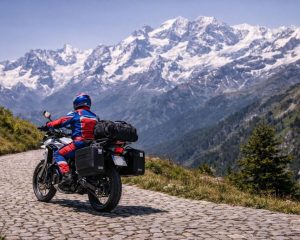
Look instead at a jacket designed in 1948, still protecting riders today, capable of crossing a mountain pass in the morning and walking into dinner that evening — then being rewaxed and taken out again years later — and the calculation begins to change.
You are not really paying for an old design.
You are paying for one that never needed replacing.