Tucano Urbano Termoscud Motorcycle Scooter Leg Covers
I first wrote about the Tucano Urbano Termoscud in 2013. More than a decade later, after using one on my Vespa GTS 250, I still think it is one of the simplest ways to make the colder riding months considerably more comfortable.
The Short Line
- Nearly thirteen years later, I still rate it: I have used a Tucano Urbano leg cover on my Vespa GTS 250 and remain extremely pleased with how well it keeps wind and rain away from my legs.
- Best when the weather starts turning: For me, the real sweet spot is autumn and early spring, when I still want to ride but no longer want every short journey to involve waterproof trousers and layers.
- Buy for the machine, not just the name: Termoscud covers are largely scooter-specific, while Tucano Urbano also offers Gaucho covers for conventional motorcycles. Correct model and year fitment matters.
Originally published September 2, 2013. Updated August 2026 after years of using a Tucano Urbano leg cover on a Vespa GTS 250.
There’s a point near the end of summer when you notice the change before you really feel it. The evenings get shorter, the air on the ride home has a little more bite to it, and that lightweight summer jacket suddenly seems optimistic.
Don Henley captured that feeling rather well in The Boys of Summer. And although I’m not quite ready to surrender the riding season yet, the final days of August are usually when I start thinking about the colder months ahead.
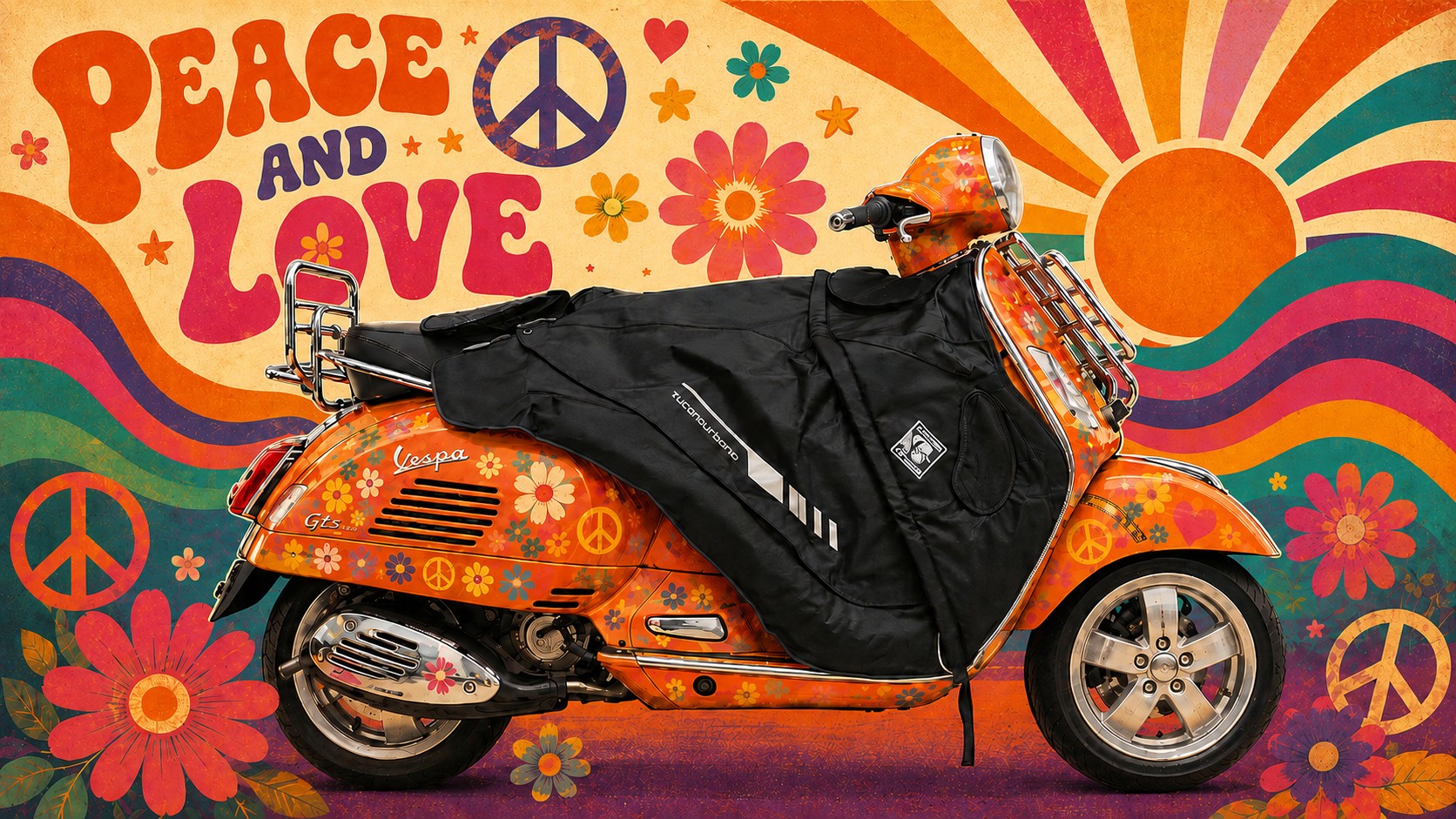
For me, that means digging out one of the least glamorous — and most genuinely useful — scooter accessories I own: my Tucano Urbano Termoscud.
Mine has been on and off my Vespa GTS 250 through many colder riding seasons, and after all this time I’m still extremely pleased with it.
It looks slightly eccentric. It adds bulk to one of the prettiest scooters ever made. And once the weather turns wet and cold, I wouldn’t particularly want to be without it.
It’s essentially a winter coat for your legs
If you’ve never seen a Termoscud, the idea can look slightly odd at first.
Rather than putting waterproof trousers over yourself every time the weather changes, the Termoscud attaches to the scooter and creates a waterproof, insulated enclosure around your legs and lower body.
That distinction matters in everyday use.
On a cool autumn morning, I don’t want to dress as though I’m setting off across the Alps just to run an errand or ride into town. With the leg cover already on the Vespa, I simply get on and go.
Rain is kept off my trousers. The wind blast that normally finds its way through denim disappears. And because your legs and lower torso aren’t being continuously chilled by moving air, the whole ride feels considerably warmer.
For commuting and everyday riding, that convenience is what has kept me using it.
It doesn’t replace proper protective motorcycle clothing — a waterproof blanket obviously provides no abrasion or impact protection in an accident — but as weather protection, it solves a problem remarkably well.
The clever part is how closely it fits the scooter
The Termoscud isn’t merely a blanket hanging over the handlebars.
Tucano Urbano uses model-specific versions designed around particular scooters. The company still describes its philosophy as essentially one scooter, one made-to-measure leg cover, which is why checking the exact model and year before ordering is important.
That close fit is part of what makes the system work.
Many of Tucano Urbano’s model-specific Termoscud covers use the S.G.A.S. inflatable anti-flap system: chambers along the sides are inflated to give the cover structure and stop it thrashing around as speed increases. The construction combines a waterproof outer layer, waterproof membrane and insulating lining.
And there is one particularly clever feature that we highlighted back in 2013.
Certain Termoscud versions use heat coming from the scooter’s radiator rather than simply allowing it to disappear into the atmosphere. On the current R154, for example, Tucano Urbano says its patented thermoregulation system directs warm radiator air inside the leg cover and prevents cold air entering when the engine is switched off.
It is such an obvious idea when you think about it: the engine is already producing heat, so why not put some of it to work keeping the rider comfortable?
Not every Termoscud uses that system, however, so it’s worth checking the specification of the version made for your scooter rather than assuming that radiator heating comes with all of them.
I’ll accept the looks for the comfort
There is a price for all this practicality, and I don’t mean euros.
A Termoscud does not improve the purity of a Vespa’s lines.
There. I said it.
Scooters generally look better without a large insulated apron wrapped around them. But this is one of those accessories where function eventually wins the argument.
Once temperatures drop and you have ridden through cold rain while remaining surprisingly dry behind the leg cover, its appearance becomes considerably less important.
That is probably the strongest endorsement I can give it. After years with one, I don’t think of the Termoscud as an accessory I added to my Vespa. When the colder riding season arrives, I think of it as part of the scooter.
Tucano Urbano built a company around this strange idea
There’s a good story behind it, too.
Tucano Urbano was born in Milan in 1999, after its founders became tired of freezing while riding scooters around the city. Their solution became the Termoscud. From that single product, the company expanded into rainwear, jackets, gloves, helmets and other urban-mobility equipment.
The concept clearly found an audience.
Tucano Urbano says roughly two million Termoscuds have now been sold, and the brand has continued developing the design rather than treating it as a product frozen in the late 1990s. The Mandelli Group has owned Tucano Urbano since 2021.
The latest Termoscud S and S-PRO versions introduce the new SCUDLOCK mounting system and three seasonal configurations. The S-PRO is aimed at larger machines such as the Yamaha TMAX Tech, Honda X-ADV 750, Honda Forza 750 and Piaggio MP3 310, while S versions cover machines including the Honda SH350, PCX125 and Yamaha NMAX125.
The current Termoscud Pro range also allows the heavy winter section to be removed while leaving part of the mounting system on the scooter, with an emergency rain cover available when required.
That makes considerably more sense for riders who use their scooters almost every day rather than treating the Termoscud as something installed in November and removed in March.
And no, leg covers aren’t only for scooters
This is where our original 2013 story deserves a little clarification.
Termoscud itself is primarily Tucano Urbano’s scooter range, but the same basic idea isn’t confined to scooters.
For conventional motorcycles, Tucano Urbano currently sells its Gaucho leg covers. The Gaucho R117, R118 and R119 use the same basic three-layer weatherproof construction and inflatable S.G.A.S. anti-flap principle, but are designed around the very different ergonomics of a motorcycle.
There are also simpler alternatives. The current Termoscud Easy, for example, is a more universal design intended principally for urban and lower-speed scooter use, while Tucano Urbano offers wearable covers such as the Linuscud and Takeaway for riders who don’t want something permanently attached to the machine.
So before buying, I would start with the motorcycle or scooter rather than with the product name. Find the version specifically recommended for your make, model and year.
That is particularly important with an older machine such as my GTS 250: don’t assume a Termoscud listed for a newer GTS 125 or 300 automatically fits an earlier 250.
Who should buy one?
If most of your riding happens between May and September, probably nobody needs to convince you to bolt a large insulated blanket onto your scooter.
But autumn riding is different.
For riders who keep going beyond summer, its sweet spot may actually be autumn and early spring — those months when the motorcycle or scooter is perfectly usable but cold wind and surprise rain make a short journey much less appealing than it should be.
That’s exactly why mine keeps coming back out.
Nearly thirteen years after we first featured the Termoscud on VivaMoto, there are newer versions, better mounting systems and considerably more choice. But the thing I like about it hasn’t really changed.
It removes one more excuse for leaving the scooter at home.
I normally do far less riding once we get properly into winter. For riders brave enough to keep going through the heart of winter, the case for a Termoscud becomes even stronger. Once cold rain, wind and near-freezing morning temperatures enter the equation, keeping your legs shielded from the weather can make the difference between a ride that feels punishing and one that is still genuinely usable.
And as the boys of summer disappear and the cooler rides return, that seems like a pretty good place to begin getting the bike ready for another season.
Final Thoughts
There are still too many good days left to put the Vespa away simply because the morning air has acquired a bite.
That is where the Termoscud has earned its place on my GTS. It isn’t glamorous, and I’ll admit that a Vespa looks better without one, but after riding through cold wind and unexpected rain with warm, dry legs, aesthetics become considerably less important.
What I appreciate most after all these years is the convenience. I don’t have to turn a short ride into an expedition. I get on the scooter and go.
For riders who continue through winter, it becomes even more useful. For the rest of us, it simply stretches the riding season a little further — and sometimes that is all I’m asking from a piece of motorcycle equipment.