Between Seasons
March is not a month for excess. The roads are still damp at their edges, the air carries a trace of cold, and confidence has not yet inflated into summer bravado. In this narrow space between restraint and expansion, the middleweight motorcycle — neither dominant nor deficient — feels less like compromise and more like clarity.
Why March Belongs to the Middleweight
There is a particular honesty to riding in March.
The roads are no longer winter-brittle, yet they have not softened into summer predictability. The light stretches longer across the afternoon, but it still carries a chill that seeps through gloves at higher speeds. Shadows fall earlier than memory suggests.
This is not a month for spectacle.
It is a month for proportion.
In such conditions, the middleweight motorcycle — that often overlooked category between excess and austerity — begins to make uncommon sense.
The litre bike, in March, feels impatient. Its reserves of acceleration remain mostly theoretical on cold asphalt. The touring flagship, built for long continental distances, seems excessive for roads still holding moisture in their shaded curves. The large-capacity adventure machine carries more presence than the season requires.
The middleweight, by contrast, feels precisely scaled.
Sufficiency
Not underpowered. Not overcommitted.
Scaled.
Between 650 and 900 cubic centimetres lies a particular balance — enough torque to move with conviction, enough restraint to avoid intimidation. In March, this balance becomes visible.
Cold tyres do not welcome abrupt throttle. Damp tarmac does not reward excess torque. The middleweight responds not with domination, but with cooperation. It allows the rider to explore the road rather than manage surplus.
There is a subtle psychological shift that accompanies this.
Large machines often encourage performance as proof. Their capability exceeds most public roads. Their power suggests ambition.
The middleweight suggests something else.
It suggests sufficiency.
Sufficiency is rarely celebrated in motorcycling culture. Spec sheets favour maxima — peak horsepower, top speed, largest displacement. Yet on a cool March afternoon, riding through secondary roads where frost once lingered, sufficiency feels like liberation.
You do not spend mental energy moderating explosive throttle. You do not brace against overwhelming acceleration. You do not carry the quiet anxiety of unused excess.
Instead, you ride within a bandwidth that feels appropriate.
March is transitional — neither winter nor spring in full bloom. The middleweight mirrors that state. It occupies a mechanical middle ground where responsiveness outweighs dominance.
And in this, it teaches something about control.
Modern middleweights are no longer modest machines. They are engineered with precision — lightweight frames, compliant suspension, electronics calibrated for real-world conditions. Their power delivery is often linear rather than theatrical. Their chassis encourages confidence without aggression.
In March, confidence is earned gradually.
Tyres warm more slowly. Muscles recalibrate. Vision sharpens bend by bend. The rider, like the season, is in transition.
The middleweight accommodates this transition. It does not overwhelm reflexes that have rested over winter. It does not demand physical exertion disproportionate to temperature or daylight.
It invites fluency.
Fluency is different from speed.
Fluency is the sensation of machine and rider moving in proportion — inputs matching outputs, feedback immediate but not urgent. It is the quiet satisfaction of maintaining rhythm through a series of bends without strain.
On a cold morning, as mist lifts from fields and early blossoms appear along hedgerows, the middleweight feels almost seasonal.
There is a humility embedded in its design. Enough power to be meaningful. Enough restraint to remain manageable.
The larger machine may assert dominance over open highways. The smaller may charm in tight urban spaces. But March belongs to the in-between — to the machine that reflects the ambiguity of the month itself.
There is also a physical reality at play.
March air density increases engine responsiveness, yet cold rubber tempers traction. Road surfaces carry the residue of winter — grit, small fractures, moisture in shade. Conditions vary within kilometres.
A balanced motorcycle becomes not merely pleasant, but practical.
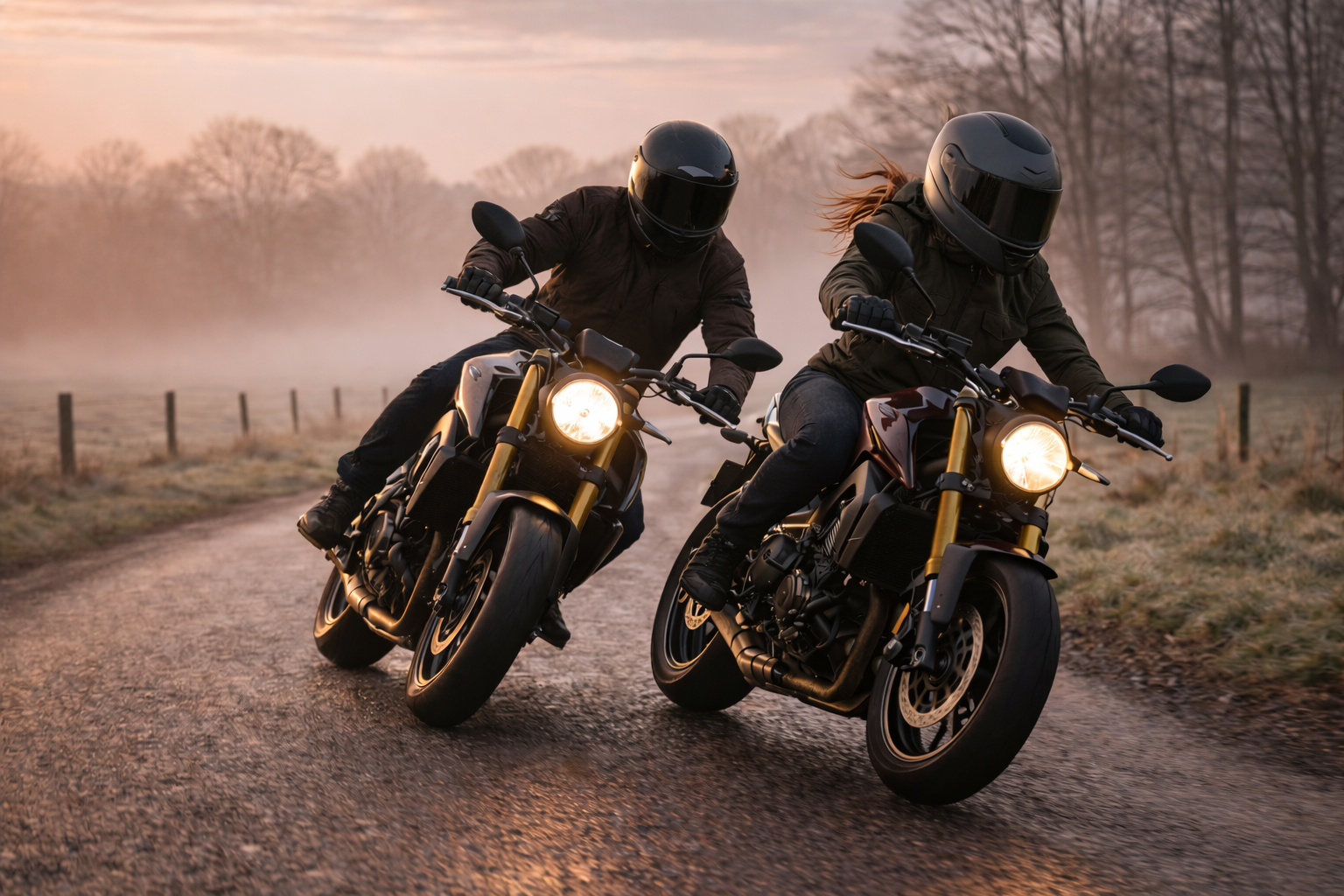
Rhythm
You find yourself riding longer than intended. Not because you are chasing horizon, but because the effort required feels sustainable. The machine asks for engagement, not correction.
In summer, the temptation is to escalate — faster, farther, louder. In March, escalation feels premature.
Restraint is not limitation. It is calibration.
The middleweight becomes an instrument tuned to that calibration.
Perhaps this is why riders often rediscover appreciation for moderate displacement after years of pursuing the largest available option. March strips away spectacle. It reduces riding to fundamentals — throttle, brake, lean, observation.
In fundamentals, balance matters more than headline numbers.
As the season advances and warmth settles into the asphalt, larger machines will reclaim their stage. High-revving engines will feel less excessive. Touring distances will lengthen.
But in this transitional month — when light grows slowly and mornings still require deliberate layering — the middleweight feels less like compromise and more like understanding.
It understands that riding is not always about extracting maximum performance.
Sometimes it is about restoring rhythm.
Sometimes it is about aligning machine capacity with seasonal reality.
Sometimes it is simply about enough.
And in March, enough is precisely right.