The Great Motorcycle Rallies Worth Riding To (At Least Once)
Some are defined by scale, others by terrain, and a few by something harder to name. What they share is simple: they draw riders from different directions toward the same point—or the same moment—and for a time, the road becomes something shared.
There is no complete list of motorcycle rallies.
Not a real one, at least. The map is too wide, the roads too varied, and the reasons for going are rarely the same. For every gathering that draws thousands, there are others—smaller, quieter, no less meaningful—known only to those who have already been.
What follows isn’t a ranking. It’s a starting point.
As explored in Where the Roads Converge, rallies are less about destination than convergence—temporary worlds formed by movement, where different roads quietly lead to the same place.
A handful of gatherings that, in different ways, show what these experiences are about—through scale, terrain, culture, or simply the feeling you’re left with after. The kind of places that come up later, when riders begin comparing where they’ve been and where they might go next.
Once the idea takes hold, it rarely stays contained.
The Weight of Winter
At Elefantentreffen—known to many simply as the Elephant Rally—everything narrows.
First held in 1956 and now set deep in Germany’s Bavarian Forest, the rally has built its reputation not through scale, but through conditions. Snow, ice, and sub-zero temperatures are not occasional—they are expected.
The cold does that first. Then the road. Then your focus.
The approach is slow, sometimes uncertain. Snow absorbs the sound of the engine, and the surface beneath you never feels entirely predictable. By the time you arrive, the ride has already asked more of you than most rallies ever will.
There’s no clean arrival point—just a gradual sense that you’re among others who made the same decision. Tents appear between trees. Fires burn low. Bikes sit where they stopped, often still marked by the road they came through.
Nothing feels arranged. It doesn’t need to be.
The Scale of It
If some rallies draw everything inward, others expand until they almost disappear into their own size.
At Sturgis Motorcycle Rally and Daytona Bike Week, you feel them before you see them.
Sturgis began in 1938 with a small group known as the Jackpine Gypsies. What it became is something else entirely—hundreds of thousands of riders arriving each August, filling the roads of South Dakota’s Black Hills in numbers that are difficult to fully grasp until you’re inside them.
Daytona traces its origins to beach racing in the early 20th century, long before the modern speedway defined it. The Daytona 200 gave it international recognition, but the surrounding streets are what sustain it—where racing culture and everyday riding meet.
The road begins to carry more riders. Stops take longer. Conversations start easily and end quickly as everyone continues in the same direction. By the time you arrive, you’re already part of something much larger than your own ride.
It builds gradually, then all at once.
At first, it can feel like too much.
But stay with it, and a pattern begins to emerge. Even at this scale, the same structure holds: riders arriving from elsewhere, sharing the same space for a while, then moving on again.
Where It All Began
Not every gathering needs scale to carry weight.
At Laconia Motorcycle Week, often described as the oldest motorcycle rally in the world, the feeling is shaped as much by time as by place.
It traces back to 1916, when early riders began arriving in New Hampshire’s Lakes Region as part of loosely organized “Gypsy tours,” long before the idea of a motorcycle rally had settled into a defined format.
By the 1930s, that continuity had begun to formalize. The Loudon Classic emerged nearby—eventually becoming one of the most respected motorcycle races in the United States, second only to Daytona. Racing, hill climbs, and informal gatherings layered themselves onto what had started simply as riders choosing the same destination.
It has changed over time. It had to.
But the structure beneath it remains recognizable: riders arriving not because it is new, but because it has always been there.
You don’t feel like you’re entering something current.
You feel like you’ve stepped into something ongoing.
The European Gathering
Around Lake Faak in Austria, European Bike Week spreads outward rather than pulling everything in.
Now considered one of Europe’s largest open motorcycle gatherings, it draws riders from across the continent each September. While closely associated with Harley-Davidson, the event itself remains open—less defined by brand than by movement.
The setting changes how you move through it.
Water on one side, mountains rising in the distance, and roads that never quite insist you stay in one place. You ride, stop, drift, then move again. The rally isn’t confined—it unfolds across the landscape.
There’s no clear center.
And because of that, the experience feels less like entering something and more like becoming part of something already in motion.
Small Machines, Long Roads
The scale shifts again at Vespa World Days, though not in the way you might expect.
Organized by Vespa clubs worldwide and hosted in a different country each year, the gathering has been running for decades—long enough to establish its own rhythm of return.
The machines are smaller. The distances are not.
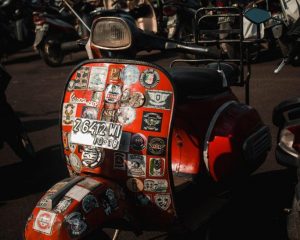
Riders arrive from across countries, sometimes further, on scooters that were never designed with long-distance travel in mind—and then quietly prove that they can handle it anyway. You notice the details first: luggage secured in ways that look adapted rather than planned, surfaces marked by miles instead of preparation.
Nothing feels exaggerated.
And nothing feels limited.
Where Culture and Movement Meet
On the Atlantic coast, Wheels and Waves resists a single definition.
Founded in 2008 in Biarritz, it emerged less from tradition than from a shift in culture—where custom motorcycles, surf, and design began to intersect in new ways.
Motorcycles, surf, and movement overlap, but the riding still holds it together. Roads lead out, then back again. People arrive for different reasons and move through it in different ways.
It doesn’t follow a fixed structure.
And that’s what allows it to hold.
Riding on the Same Day
Not every gathering asks you to arrive somewhere.
Some unfold across cities, across countries, across time zones—held together not by place, but by timing rather than destination.
At The Distinguished Gentleman’s Ride, first organized in 2012, riders move through different streets within a shared frame of reference. The route changes, the surroundings shift, but the structure holds. What matters is the awareness that, elsewhere, the same thing is happening at the same time.
You don’t see it all, but you begin to sense it—through the familiarity of the movement, the way the ride carries a slightly different weight when it is no longer entirely your own.
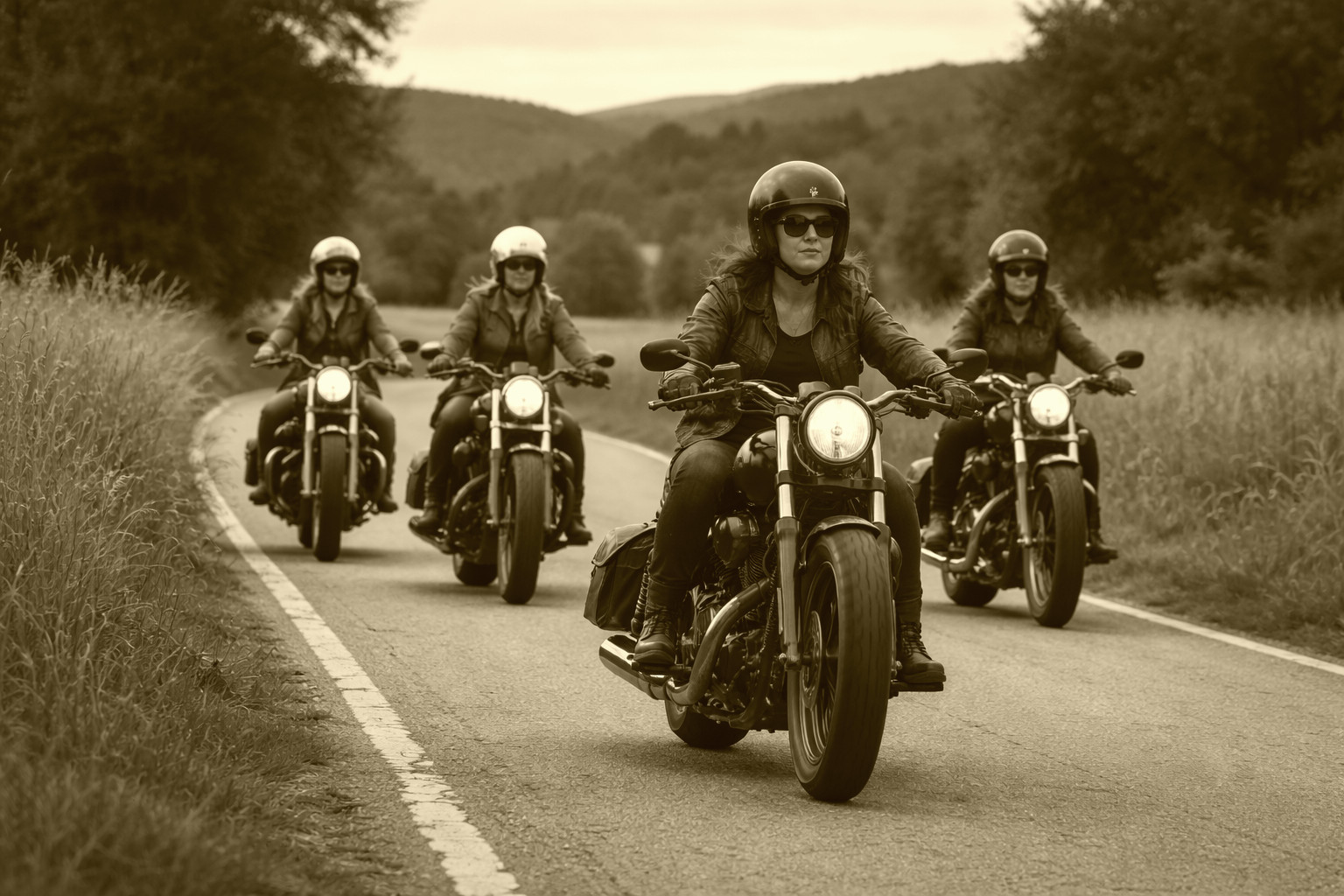
The same holds for International Female Ride Day, established in 2007, and Ride to Work Day. There is no shared destination, no single point of arrival—only riders setting out from where they already are, moving through their own roads with a quiet awareness of others doing the same.
The connection is less visible, but no less present. It builds not through proximity, but through timing—through the understanding that the experience extends beyond what can be seen at any one moment.
It isn’t about reaching the same place, but about riding within the same moment.
The Road That Connects Them
Whether riders converge on a place or move within the same moment, the structure is the same.
Someone decides to go.
Not always with a clear plan. Not always knowing what they’ll find. Just the sense that somewhere ahead—or somewhere else—others are already moving in the same direction.
And that’s enough.
You leave.
You ride.
You arrive.
And somewhere along the way, without needing to define it, the experience becomes shared.