Jupiter’s Travels — Endurance, Attention, and the Long View
A motorcycle journey that became a template for modern travel writing—measured not in miles, but in attention. First published in 1979, Jupiter’s Travels remains one of the most quietly influential works of travel literature. Ted Simon’s four-year circumnavigation on a Triumph Tiger is less a chronicle of distance than a sustained exercise in observation—patient, humane, and resistant to spectacle.
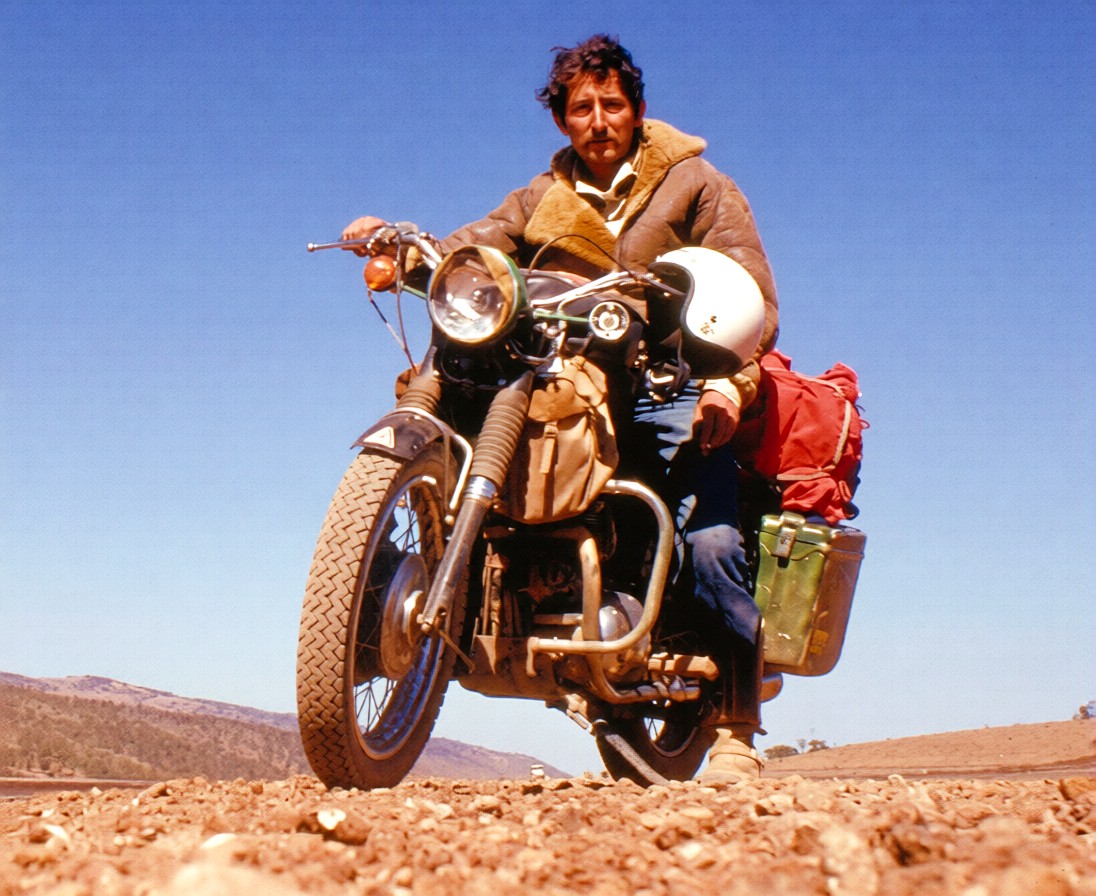
Before it became a touchstone for overland travel, Jupiter’s Travels was simply a man leaving London with a question. The scale—four years, 64,000 miles, 45 countries—only later acquired its weight. At the outset, the journey was smaller in intent and larger in uncertainty.
The Journey Without Myth
When Ted Simon left London on 6 October 1973 aboard a 500cc Triumph Tiger 100, he was forty-two years old and already several lives removed from where he began. Raised in London by a German mother and a Romanian father, Simon trained first as a chemical engineer before abandoning that path for Paris, where journalism became his vocation. Travel, in his case, was less a departure than a continuation of inquiry.
The journey that followed lasted four years, covering approximately 64,000 miles through 45 countries. Simon resisted framing it as an act of endurance. “People who thought of my journey as a physical ordeal or an act of courage… missed the point,” he wrote. Courage, he suggested, was simply equipment. “The goal was comprehension,” and comprehension required vulnerability—remaining open long enough for the world to alter one’s perspective.
He later traced the idea’s origin to a moment of unease: watching a television programme about poverty, he realised that despite his professional background he was, as he put it, “really very ignorant about the world.” Travel became a corrective, a way of testing perception against lived experience.
Simon was already an experienced journalist, and the habits of that discipline shape the narrative. His prose is measured and curious, alert to contradiction and wary of conclusions reached too quickly. Early in the book, he asks a deceptively simple question—“How do you prepare for the unknown?”—and allows the journey to answer it.
The motorcycle itself was chosen deliberately. Simon later acknowledged that while a motorcycle was “bloody dangerous,” it demanded exposure and engagement in equal measure. Risk was part of the honesty.
The Triumph, named Jupiter, is never elevated to symbol or fetish. It breaks down, demands compromise, and repeatedly places Simon in vulnerable positions. By resisting romanticism, the book keeps its focus on experience rather than projection, a decision that separates it from many later adventure memoirs.
Encounters Over Itineraries
What gives Jupiter’s Travels its depth is not mileage but attention. Simon listens carefully—to villagers, border officials, fellow travellers—and records those encounters without compressing them into anecdote. Cultures are not reduced to scenery, nor are people treated as narrative devices.
The structure reflects this ethic. Some regions receive sustained, immersive treatment; others pass quickly. The imbalance feels honest rather than careless. Long journeys do not impress themselves evenly on memory, and Simon makes no attempt to impose symmetry where none existed.
His imprisonment in Brazil, one of the book’s most cited sections, unfolds without melodrama. The tension accumulates through observation rather than spectacle. The Los Angeles Times later noted the book’s ability to convey action and danger through keen observation and perceptive insight—an assessment borne out precisely because Simon resists exaggeration.
Interior Terrain
As the journey stretches into years, the narrative’s centre of gravity shifts inward. Fatigue replaces novelty. Doubt replaces momentum. These passages are among the book’s most compelling, not because they are confessional, but because they are unforced.
Near the journey’s end, Simon describes watching a body drift along the Ganges—an image that initially repels him, then unexpectedly settles into calm. The moment reframes his understanding of impermanence without commentary or insistence. Meaning is allowed to surface gradually.
Reception and Legacy
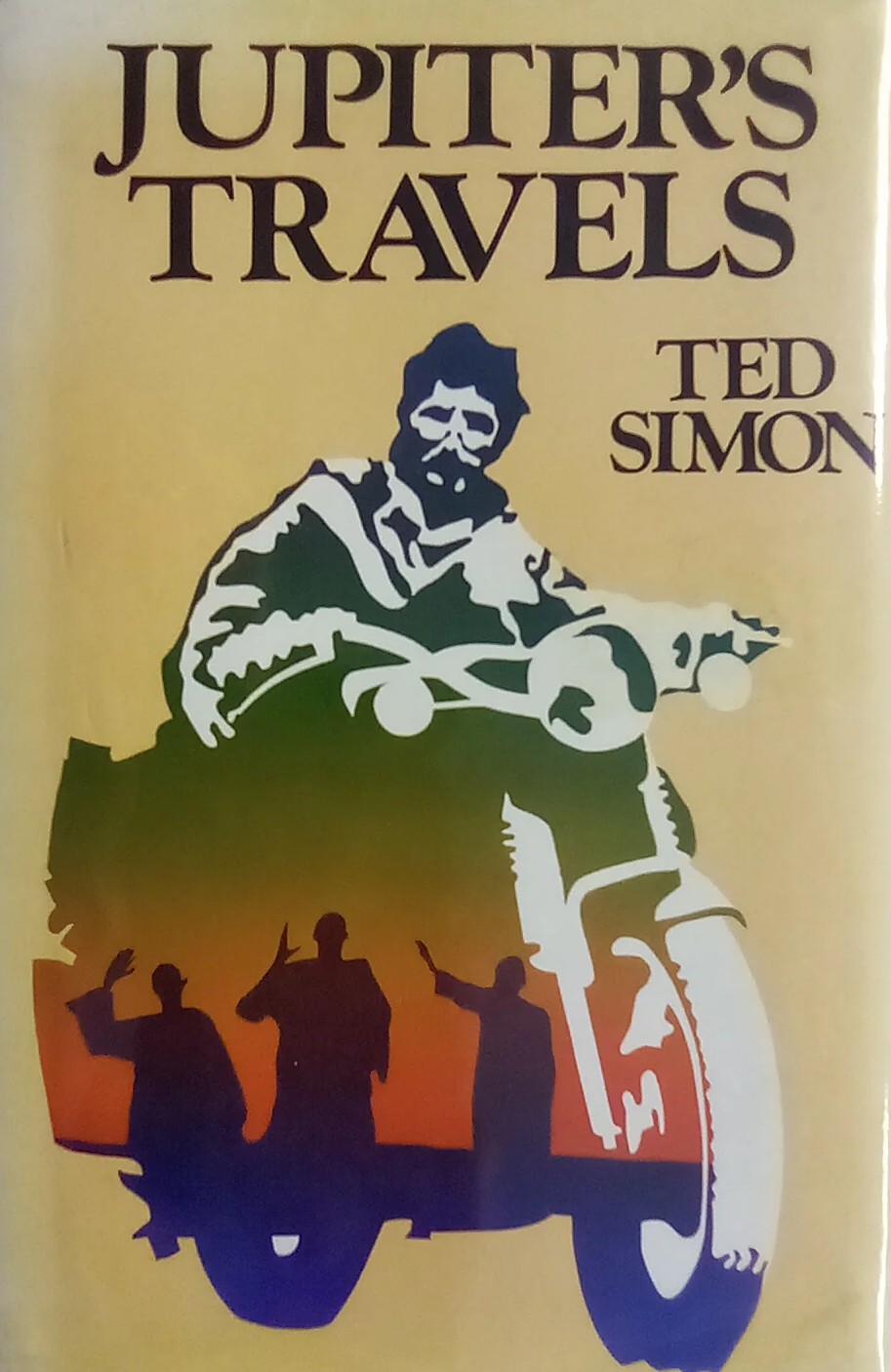
Although Jupiter’s Travels did not receive universal mainstream attention on release, it has since been widely recognised as a landmark in travel literature. Writing in The Telegraph, Andrew English described it as “so much more than a motorcycling book,” praising Simon’s prose as “immaculate, knowing and unabashedly humble.”
The book’s influence extends well beyond motorcycling. It is frequently cited by later generations of travellers not because it encourages imitation, but because it models a way of moving through the world grounded in patience, humility, and sustained attention.
Simon himself remarked on the book’s longevity. “What’s extraordinary about it,” he observed, “is how long it has survived and how well it is still doing.” Its endurance, he suggested, lay not in the journey itself, but in the experience it articulated.
Contextual Framing
Read today, Jupiter’s Travels stands apart from much contemporary travel memoir by what it refuses to turn into spectacle. The journey is not framed as self-reinvention, nor as performance for an audience. Compared with later overland narratives such as Long Way Round, Simon’s authority comes from duration and exposure rather than momentum, allowing meaning to accumulate quietly over time.
At the same time, the book anticipates a modern strain of travel writing concerned with attention rather than conquest. Like The Old Ways, it treats movement as a way of thinking, though Simon learns through friction and delay rather than history or language. The road offers no thesis or resolution—only a condition that reshapes perception.
What Came After
On 27 January 2001, nearly three decades later and aged sixty-nine, Simon set out again—this time to see how the world had changed. Riding a BMW R80 GS, he travelled approximately 59,000 miles through 47 countries. Reflecting on the experience, he noted that the end of a long journey can be as difficult as its beginning, describing the return home as “a very hard thing to negotiate.”
Between the two circumnavigations, Simon lived for a period in Northern California, working in organic farming and continuing to write, later publishing The River Stops Here. Now based in southern France, he remains active through his long-running weblog, Jupitalia.
A Book That Trusts Time
Jupiter’s Travels endures because it does not hurry the reader. It trusts accumulation—of miles, conversations, and moments whose significance only becomes clear in retrospect. It offers no instructions, no exhortations, no manifesto. Instead, it records what can happen when someone remains exposed to the world long enough for certainty to erode.
This is not a book about going faster or farther. It is a book about attention—and what that attention can quietly yield.
This article was originally published on January 31, 2017, and has been updated, on February 19, 2026.